
2. Types of Machine Learning & their basic workflow

In previous article of our ML journey , we explored what machine learning is and how it’s deeply integrated into our everyday lives—from voice assistants to Google Maps to health tech. But now it’s time to go a level deeper.
In this article, we will talk about The types of Machine Learning and what a basic ML workflow looks like.
Types of Machine Learning
Supervised Learning — "Learning with Labels"
Imagine you're teaching a child to recognize fruits. You show them apple and say “this is a apple.” That’s supervised learning—we give the machine both the input (features) and the correct output (label) during training. So machine learn pattern from examples and base on that it predicts in the future.
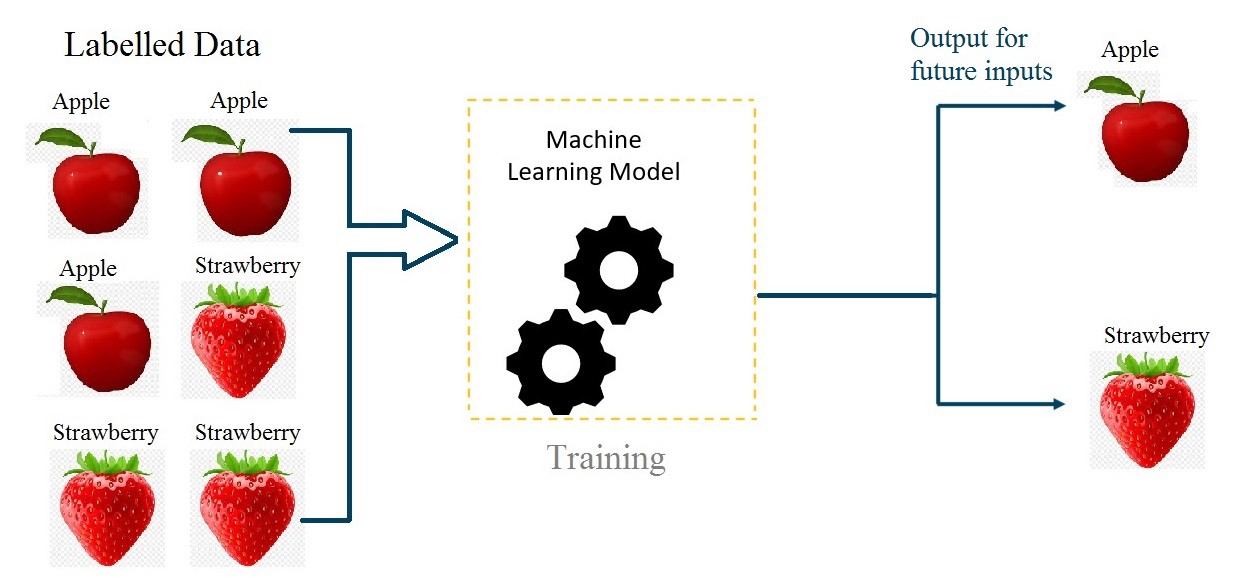
Types of supervised learning
This is based on the types of final output/label.
- Classification (Predicting a label or category )
Binary Classification: Two outcomes (e.g., spam or not spam)
Multiclass Classification: More than two outcomes (e.g., classifying types of fruits)
- Regression (Predicting continuous values)
- Example: Predicting house prices based on size and location
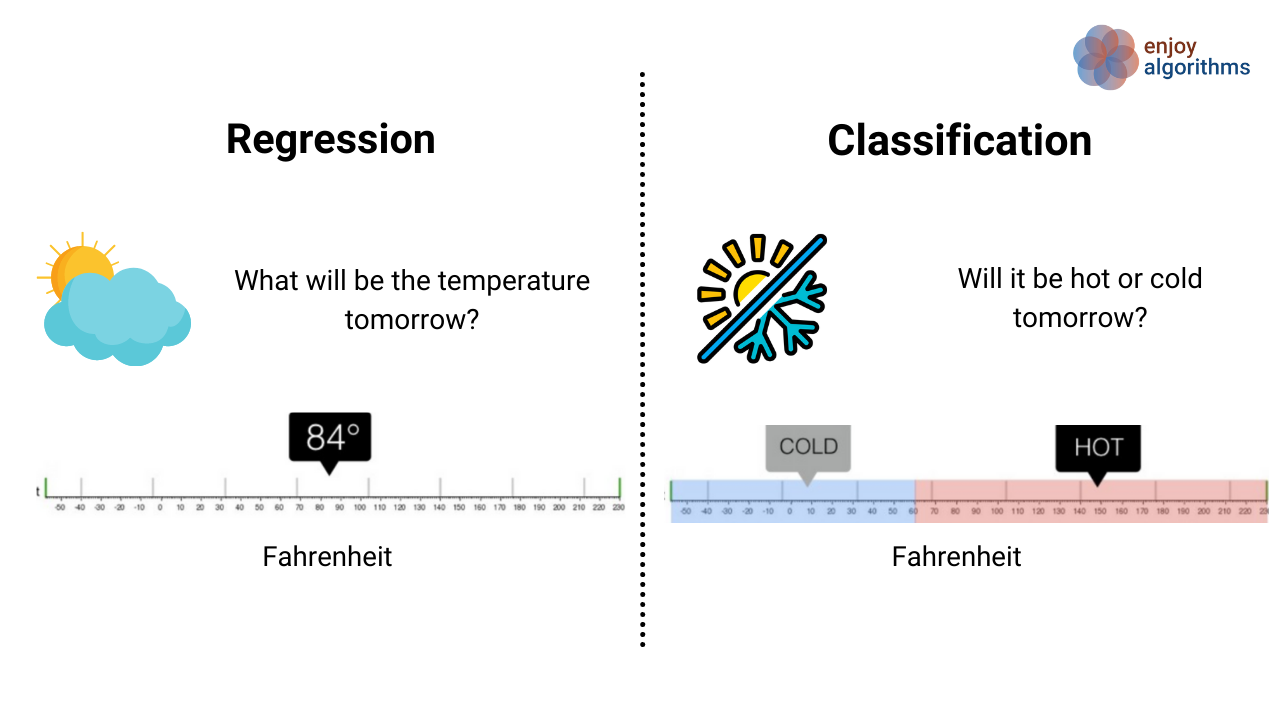
Common Supervised Learning Algorithm
Few are the common algorithms that are used.
Logistic Regression – Used for binary classification problems
Decision Trees – Splits data into decision nodes for easy predictions
Random Forest – An ensemble of decision trees for better accuracy
Support Vector Machines (SVM) – Finds the best boundary between classes
K-Nearest Neighbors (KNN) – Classifies based on closest data points
2. Unsupervised Learning — "Learning Without labels"
Here, the model works on unlabeled data—no answers are given. It tries to find hidden patterns or structures all by itself.Imagine giving a bunch of photos of apples to a computer and asking it to group similar ones—without telling it what each photo is. That’s unsupervised learning. It finds hidden patterns or structures in data.

Three Main Categories:
1. Clustering: process of grouping similar data points together based on their characteristics, without using labeled outcomes.
Examples
Customer segmentation: Grouping customers by buying habits
Document clustering: Grouping news articles by topic
Social media analysis: Finding communities within a network
2. Dimensionality Reduction: Dimensionality reduction reduces the number of input variables while preserving essential patterns.
It’s like compressing a high-res image without losing much quality—making it easier to store, analyze, and visualize.
Examples
Image compression
Gene expression analysis in biology
Feature reduction before training deep learning model
3. Anomaly Detection ( outlier detection) is about finding data points that don’t conform to the expected pattern—like catching a glitch in the matrix.
Think of a bank transaction that suddenly spikes at 3 AM in a country you’ve never been to. Your bank’s machine learning system probably flagged that as suspicious.
Examples
Credit card fraud detection
Server/network intrusion detection

Common Algorithms:
K-Means Clustering – Groups data into k clusters
Hierarchical Clustering – Builds a tree of clusters
Principal Component Analysis (PCA) – Reduces dimensions for better visualization
t-SNE – Visualizes high-dimensional data in 2D/3D
Reinforcement Learning
In reinforcement learning, an agent learns by interacting with its environment and receiving rewards or penalties based on its actions.
It’s like teaching a dog: reward for a trick well done, correction when it doesn’t obey.

Common Algorithms:
Q-Learning – Learns the best action to take in a given state
Deep Q-Networks (DQN) – Combines Q-learning with neural networks
SARSA – Similar to Q-learning but learns using the actual action taken
Basic Workflow
Regardless of the type, most ML projects follow a common workflow:

Problem Definition: What do you want to solve or predict?
Data Collection: Gather the necessary data
Data Preprocessing: Clean, format, and split the data
Model Selection: Choose the right algorithm
Training the Model: Teach it using training data
Evaluation: Test with unseen data to check performance
Tuning: Improve accuracy with hyperparameter tuning
Deployment: Use the model in a real-world application
Conclusion
Understanding the types of machine learning is like learning how different superheroes use their powers. Each type has its unique way of learning and solving problems. So whether you're building a spam filter, a chatbot, or training an AI to play chess, knowing which ML type to use is your first step toward success


