
Reinforcement Learning: The Big Picture

In the previous posts of this series, we explored Supervised Learning, where models learn from labeled data, and unsupervised learning, where patterns are discovered without labels.
But what if there are no labels, no predefined groups, and no clear instructions, and only a goal to achieve?
Imagine playing a new video game for the very first time. You don’t know the rules, the controls, or the shortcuts. All you know is that you want to clear the level, score the highest points, or win the game. You start by pressing random buttons, observe what happens, and slowly improve based on feedback.
This is where Reinforcement Learning (RL) comes into the picture.

Why Reinforcement Learning Exists
Not all problems fit into supervised or unsupervised learning.
In many real-world scenarios:
There is no labeled dataset
The system must make a sequence of decisions
Feedback is often delayed
Learning happens through experience
Humans naturally learn this way:
A child learns to walk by falling and adjusting
We learn to ride a bicycle by trial and error
Gamers improve by repeatedly playing levels
Reinforcement learning allows machines to learn in the same way—by interacting with their environment and learning from feedback.
What Is Reinforcement Learning?
Reinforcement Learning is a branch of machine learning where an agent learns by interacting with an environment and receiving feedback in the form of rewards or penalties.
Instead of being told what the correct answer is, the agent:
Takes actions
Observes the outcome
Receives feedback
Improves its decisions over time
The ultimate objective of the agent is simple:
Maximize the total (cumulative) reward over time
Common examples include:
A game character learning to finish levels
A robot learning how to walk
A self-driving car learning safe driving behavior
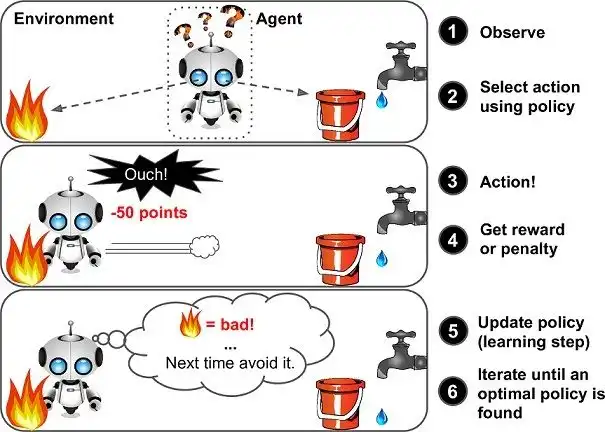
Core Concepts of Reinforcement Learning
To understand reinforcement learning, you only need a few essential concepts. These form the foundation of everything that comes later.
| Concept | Description |
| Agent | The learner or decision-maker |
| Environment | The world the agent interacts with |
| State | The current situation |
| Action | A possible move the agent can make |
| Reward | Feedback from the environment |
| Policy | The strategy used to choose actions |
| Episode | One complete run from start to end |
Let’s understand this with a simple example.
Imagine a game like Mario:
Mario is the agent
The game world is the environment
Mario’s position is the state
Jumping or moving is an action
Coins and points are rewards
Clearing the level is the goal
How Reinforcement Learning Works
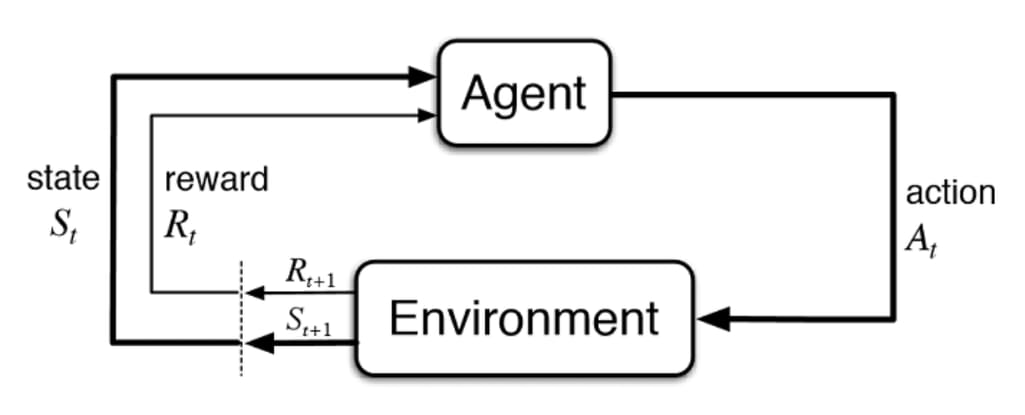
Reinforcement learning follows a continuous feedback loop:
The agent observes the current state of the environment It selects an action based on its policy. The environment responds with a reward (or penalty). The agent moves to a new state. The agent updates its strategy based on experience. Over time, the agent learns which actions lead to better outcomes.
A key challenge in this process is balancing:
Exploration – trying new actions to gain knowledge
Exploitation – using known actions that give good rewards
This balance is crucial for effective learning.
Types of Reinforcement Learning

At a high level, reinforcement learning can be categorized into two main types.
Model-Based Reinforcement Learning
In model-based reinforcement learning:
- The agent builds an internal understanding of the environment. It learns how actions affect future states and rewards. The agent can plan before acting
This approach is often more sample-efficient but harder to design for complex environments.
Model-Free Reinforcement Learning
In model-free reinforcement learning:
The agent does not build an internal model. Learning happens purely through trial and error. This approach is widely used in practice
Model-free methods are simpler and more flexible, especially in dynamic or complex environments.
Common Reinforcement Learning Algorithms
There are many reinforcement learning algorithms, each designed for different types of problems. Some well-known ones include:
Q-Learning
SARSA
Deep Q-Networks (DQN)
Proximal Policy Optimization (PPO)
Real-World Applications of Reinforcement Learning

Reinforcement learning is widely used in real-world systems where learning through interaction is essential.
Some notable applications include:
Games: Chess, Go, Atari, and other strategy games
Robotics: Learning optimal movements and control
Recommendation systems: Personalizing content over time
Autonomous driving: Learning safe and efficient driving strategies
Finance: Trading and portfolio optimization
All these problems share a common theme—learning by trial and error.
Final Thoughts
Reinforcement learning is fundamentally different from other machine learning paradigms. Instead of learning from static data, it learns from experience. This makes it powerful, flexible, and well-suited for complex decision-making problems.
In the next article, we’ll dive deeper into Q-Learning and understand how an agent actually learns from rewards without writing complex code or equations.
Let’s follow us ML Diaries by Fahd


